Kitchen Blood & Burn: Your Non-Negotiable Restaurant Trauma Kit
That moment of truth. A high-speed kitchen, a razor-sharp blade, a slick of grease, or a splash of boiling oil. In the pressure cooker of food service, it’s not a matter of *if*, but *when* something goes sideways. Are you honestly geared up to manage the fallout when the unexpected hits hard? We’re blowing past the standard plaster and gauze to arm you with a battle-tested strategy for trackside medical emergencies, restaurant style.
When Your Crew Goes Down: Why a Generic Kit is a Death Sentence
Listen up. A standard first aid kit is for scrapes on the playground. In a commercial kitchen, you’re dealing with industrial-grade hazards. OSHA regulations (29 CFR 1910.151(b)) aren’t just suggestions; they’re the bare minimum, the starting line. And ANSI/ISEA Z308.1 standards? Those are your baseline. Blow past them. Because when a line cook suffers a deep laceration from a mandoline slicer or a server takes a spill carrying a full tray of sizzling fajitas, the fines are the least of your concerns. The real cost is in the mangled hand, the lost income, the lawsuit, and the absolute destruction of morale. Rapid, decisive action doesn't just save a limb; it saves your operation from going under.
From Fryer Burns to Knife Wounds: Your Battle-Tested Restaurant Medkit
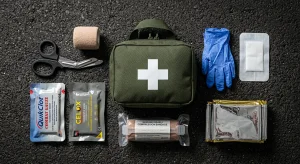
Picture the chaos: razor-edge blades, boiling vats of oil, slick tile floors, heavy stockpots, and pressurized equipment. You’re talking about deep cuts, third-degree burns, high-speed slips, blunt force trauma, and choking incidents. This isn’t about a boo-boo. This is about critical intervention. Your kit isn’t just a box; it’s your immediate response unit. Here's what needs to be in it, and why:
- Food-Safe Blue, Metal-Detectable Bandages: Forget beige. If a bandage pops off mid-prep, that vivid blue screams DANGER! in a way beige never will. The metal strip? That’s your last line of defense against serving up a side of contamination. Your metal detector catches it; your reputation doesn't get shredded.
- Industrial-Strength Burn Dressings and Gels: Not a little tube of aloe. You need hydrogel dressings to stop the thermal assault on skin and specialized burn sheets to cover significant surface area. The goal is to immediately arrest the cooking process of flesh from scalding water, grease flashes, or open flame.
- Sterile Trauma Pads and Pressure Dressings: Forget tiny squares. You need serious gauze pads (4x4, 5x9), roller gauze, and self-adhering wrap. When an artery is gushing from a knife wound, you need to pack it, press it, and hold it. Volume matters.
- Heavy-Duty Nitrile Gloves: Don't even think about latex. Not only are allergies a concern, but you need an impervious barrier. Their blood, your pathogens – keep it separate. Always have multiple pairs.
- Trauma Shears, Waterproof Tape, and Sterile Eyewash Stations: Not kindergarten scissors. We're talking shears designed to cut through clothing, even thin denim, without compromising the injury. Tape that actually sticks, even when wet. And a *dedicated* eyewash station – not a tiny bottle – to flush corrosive cleaners or splashed hot oil from an eye for a full 15 minutes.
- CPR Barrier Device and Pocket Mask: If someone collapses and their airway is compromised, you need to deliver rescue breaths. A barrier protects both you and the victim from direct fluid transfer during mouth-to-mouth resuscitation. Know how to use it.
- Instant Cold Packs (Ample Supply): For sprains, strains, blunt force trauma from a dropped container, or reducing swelling after a fall. Get the big ones.
Your Class A or B kit is a regulatory starting point. It’s a foundation. Build on it. Scale it up for your crew size and the specific hell your kitchen can unleash.
Zero Excuses: Placement, Training, and Vigilance
A pristine kit locked in the office is a museum piece, not a life-saving tool. It needs to be screamingly obvious, brightly labeled, and accessible without fumbling under pressure. One in the kitchen, one in the server station, maybe one more near the dish pit. Think about where the most brutal injuries happen, and put a kit there. Immediately.
Training is not a suggestion. It’s a hard requirement. Every single team member needs to know where the kits are and how to deploy the basics – how to apply direct pressure, how to cover a burn, how to recognize choking and perform the Heimlich. This isn't optional; it's part of their job description.
And maintenance? This isn't a "when I get around to it" task. Check those kits weekly. After every incident, restock immediately. Expiration dates on sterile supplies are non-negotiable – out-of-date sterile items are contaminated items. Designate a specific "Medic" on each shift, someone who owns the readiness. Because when the siren wails, you don't have time for guesswork.
FAQ: Restaurant Trauma Preparedness – No Holds Barred
What are the absolute minimum OSHA requirements for restaurant first aid kits?
OSHA (29 CFR 1910.151(b)) mandates "readily available" and "adequate" first aid supplies. They often point to ANSI/ISEA Z308.1 Class A or B standards as a baseline, scaled for your specific hazards and headcount. But here's the kicker: "adequate" is subjective until someone gets hurt. If your kit isn't sufficient for a common kitchen trauma, you're on the hook. Compliance is the floor; preparedness is the ceiling. Aim higher.
Why are those blue, metal-detectable bandages so critical for food service?
Because nobody wants a bandage in their bolognese. The vibrant blue makes it impossible to miss if it detaches and falls into food. The embedded metal strip means that if it does somehow slip past visual checks, your industrial metal detectors will flag it. This isn't just about hygiene; it's about preventing product recalls, massive financial hits, and the catastrophic loss of consumer trust when foreign objects are found in food. It's a critical control point for food safety.
How often do I need to check and restock my restaurant first aid kit – really?
Real talk? You check it at the start of every shift. A quick visual scan to ensure nothing's been pilfered, nothing's obviously expired or damaged. A full inventory and expiration date check? That's a mandatory weekly task. After *any* use, it's restocked immediately. Don't wait for a monthly schedule. A sterile item with an expired date is no longer sterile – it's a liability waiting to happen. Treat it like a pre-flight checklist. Your crew’s safety depends on it.