Roadside Trauma Kit: Your Lifeline When the Asphalt Bites Back
You push pedals for the freedom, the sheer grit of it. The open road stretches, the climbs beckon, the descents are pure exhilaration. You’re out there, miles from anywhere, just you and the machine. That’s the dream.
Then the dream shatters. Because the road, my friend, is a brutal, unforgiving mistress.
One moment you're tucked, hitting 35 mph on a perfect line, heart hammering to the beat of your own effort. The next, a gravel patch, a blown tire, or a group ride pile-up has you sliding across asphalt at speed, your bike a mangled wreck, and your body taking the hit.
That’s why carrying a dedicated roadside trauma kit isn't about *if* something bad will happen. It’s about *when* it happens, ensuring a broken clavicle or deep road rash doesn’t spiral into a sepsis risk or a hypothermic nightmare before help arrives.
Why Your Trailside Trauma Kit Needs to be a Hell of a Lot More Than Your Bathroom Band-Aid Box
That flimsy first aid pouch under your sink is for paper cuts and splinters. It’s for when a hospital or pharmacy is a five-minute drive away. Out on the bike, sometimes you're hours from even cell service, let alone a sterile environment.
When you're grinding through remote canyons, blasting down deserted backroads, or pushing a century in the backcountry, the nearest ambulance might as well be on the moon.
A proper trauma kit is what keeps you or your riding partner from bleeding out, going into shock, or battling a crippling infection in the middle of nowhere. It helps you manage:
- Gaping road rash and deep lacerations
- Puncture wounds from pedals or broken spokes
- Fractures and dislocations (stabilization, not repair)
- Severe saddle sores and friction burns from endless hours in the saddle
- Anaphylactic shock from a bee sting to the throat
- Dehydration and heat exhaustion far from water sources
Think of it not as a "buddy," but as your last line of defense. It takes up minimal saddle bag space, doesn't weigh you down, and sits dormant until the exact moment you're praying you packed it.
What Goes Into a Kit That Actually Saves Your Ass?
Forget the cutesy illustrations. Your kit isn't for boo-boos. It's for preventing a bad situation from becoming critical.
Wound Management & Hemorrhage Control
Road rash isn't a "small injury." It's an open wound the size of a dinner plate, often laced with dirt, gravel, and shredded Lycra. You’ll need serious gear.
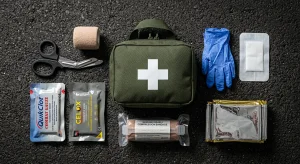
- **Trauma Dressings:** Not just small adhesive bandages. Think 4x4 or 5x9 sterile pads, even a 10x30 abdominal pad. For high-speed asphalt abrasions, you need to cover and protect, not just slap on a tiny strip.
- **Self-Adherent Wrap (Coban/VetWrap):** Holds those dressings in place when tape won't stick to bloody, sweaty skin. Also good for light compression.
- **Medical Tape:** 1-inch durable athletic tape, not cheap paper tape.
- **Gloves:** Nitrile, minimum two pairs. You don't want someone else's blood in your system, and you don't want to contaminate their open wound.
- **Trauma Shears:** Forget dainty scissors. These are for cutting through jerseys, bib shorts, even hydration packs, to get to the injury without moving the patient too much.
- **Tweezers:** For picking out gravel, glass, and chain grease from open wounds.
- **Saline Irrigation:** Small bottle, minimum 100ml. Don't use stream water or your last swig of electrolyte drink to clean an open wound. You're trying to prevent infection, not introduce more pathogens.
- **Antiseptic Wipes:** Povidone-iodine or chlorhexidine wipes for cleaning *around* the wound after irrigation.
- **Sterile Gauze Rolls:** For packing deeper wounds, if you're trained, or just absorbing massive amounts of blood.
- **Pressure Bandage / Israeli Bandage:** This is not optional. For severe bleeding, direct pressure is key, and these apply it without you needing to hold it for an hour.
These items aren't for comfort. They're for stopping the bleed, preventing infection, and covering the raw, exposed flesh that’s been introduced to the road.
Personal Protection & Environmental Control
It's not just about the wound. It's about you, the responder, and the overall situation.
- **Cleaning Wipes:** Hand sanitizer for your hands *before* donning gloves, and robust antiseptic wipes for cleaning tools or surfaces.
- **More Protective Gloves:** Always pack more than you think. Bloodborne pathogens are a real threat.
- **Space Blanket (Mylar Blanket):** A hypothermia risk isn't just for snow. A rider in shock, lying on cold asphalt, can crash their core temperature fast. This is lightweight, tiny, and can be a lifesaver.
- **Headlamp:** You don't always crash in daylight. Trying to manage trauma with your phone's flashlight is a joke.
Keeping your gear clean and yourself safe is just as vital as treating the injured rider.
Immediate Relief & Systemic Support
Sometimes the biggest threat isn't a gash, but the body's reaction to the trauma, or just the accumulated stress of an endurance effort.
- **Painkillers:** Ibuprofen (anti-inflammatory for swelling) and Acetaminophen (for pain without thinning blood). Don't just pack two tablets. You're riding for hours; a sustained ache can break you.
- **Anti-Histamines:** For allergic reactions to bee stings (common on bike rides), pollen, or an unknown plant exposure.
- **Anti-Diarrhea Meds:** Nothing shuts down a long ride faster than GI distress from bad food, race jitters, or a bacterial hitchhiker.
- **Oral Rehydration Salts (ORS):** Far superior to just water for someone showing signs of dehydration or heat exhaustion.
- **Personal Medications:** Insulin, inhalers, EpiPens. If you or your riding partners need it, it's not optional.
Because nobody wants a gut-wrenching cramp or an allergic reaction to turn a minor inconvenience into a full-blown emergency 50 miles from the nearest town.
Check That Kit Like Your Life Depends On It Before Every Ride
A trauma kit that's been rattling in your frame bag for a year, forgotten and uninspected, is about as useful as a chocolate teapot. It's not a museum piece.
Before every major ride, especially solo or remote adventures, you need to:
- **Verify Expiration Dates:** Especially for medications and sterile supplies. Expired meds are useless; degraded sterile wraps are a contamination risk.
- **Restock Used Items:** Did you burn through your gauze on that last group ride washout? Replace it. Immediately.
- **Inspect for Damage:** Has anything gotten wet, crushed, or compromised? Carbon frame integrity checks aren't just for your bike.
- **Ensure Accessibility:** Can you get to it one-handed, in the dark, in a panic? If it's buried under a week's worth of gear, it's in the wrong place.
Also, consider the specific hell you're riding into.
Hitting desert roads? Pack extra ORS, sunblock, and maybe a snake bite kit if you're truly out there.
Alpine passes? Think hypothermia: more space blankets, hand warmers, waterproof matches.
Touring with a bike trailer? Your kit needs to be modular, accessible from *any* part of your setup, not just the front pannier.
Final Directive
Riding is about the raw experience, the challenge, the unforgettable moments. A proper roadside trauma kit simply ensures those moments aren't remembered for blood, panic, and regret.
It’s the silent, uncomplaining passenger in your peloton that no one acknowledges—until the moment someone gasps:
“Thank God you packed this.”
A few minutes of prep means the difference between a ride-ending injury and a potential life-threatening incident. Pack smart, ride hard, and be damn well ready for anything the road throws at you.
FAQ
Q1: What's the real difference between a home first aid kit and a bike trauma kit?
A home kit handles kitchen cuts. A bike trauma kit, especially for endurance cycling, must handle high-energy impact injuries, deep abrasions, heavy bleeding, and provide stability when you're hours from any medical facility. It's about remote, real-world trauma, not minor inconveniences.
Q2: What's non-negotiable for a cycling trauma kit?
Absolutely non-negotiable: trauma shears, nitrile gloves, a self-adherent wrap, a pressure bandage (Israeli bandage), sterile pads large enough for serious road rash, and an oral rehydration solution. Anything less is a gamble you don't want to take.
Q3.: Where do I stow this on my bike?
Somewhere *instantly* accessible. Not in the bottom of a pannier, not wrapped in a jersey in your frame bag. A dedicated top tube bag, an external saddle bag pocket, or a separate pouch easily grabbed from a backpack. If you have to dig for it, it's in the wrong spot.
Q4: How often should I inspect my trauma kit?
Before *every* significant ride or race. At minimum, monthly. Check for expired items, anything that's been compromised by moisture or crushing, and restock immediately after use. This isn't a set-it-and-forget-it item; it's active gear.
Q5: What size kit for different types of rides?
For a quick hour-long spin, you might get away with minimal items. But for anything over two hours, or truly remote, you want the full trauma loadout. It's not about convenience; it's about covering the worst-case scenario. When you’re 100 miles into a bikepacking trip, you don't have the luxury of a "compact" problem. Your saddle bag space constraint is real, but so is massive blood loss. Prioritize capability over compactness.