Why First Aid Kits Aren't Just One Big Pocket
Pick up any substantial first aid kit, and you'll immediately notice an array of features:
Clear pouches. Mesh pockets. Zippered sections. Elastic loops.
Your first thought might be:
“Is all this really necessary for a first aid kit?”
The short answer? Absolutely.
Those specialized first aid kit compartments aren't just for show. They're designed to solve a fundamental problem:
When an emergency strikes, you need to find what you're looking for immediately, not rummage through a chaotic pile.
Imagine cramming adhesive bandages, sterile gauze, medical tape, gloves, shears, antiseptic wipes, and dozens of small packets into a single, undifferentiated space.
Initially, it might look organized.
Then you toss it in the car.
Drive for a few weeks.
Take it on a camping trip.
Shove it back in the trunk.
And the next time you open it?
Chaos.
The bandages have migrated to the bottom. Your shears are lost beneath the gauze. And those tiny packets? They've formed their own miniature ecosystem in a corner.
This is precisely why a well-conceived organized first aid bag allocates specific homes for different supplies, rather than consolidating everything into one giant abyss.
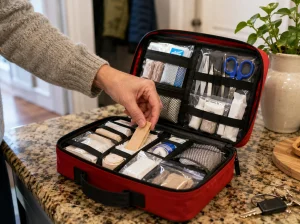
Clear Pouches: Instant Visibility, Zero Frustration
The brilliance of a clear pouch lies in its simplicity.
You can see inside.
That's it. That's the whole point.
But when seconds count, this seemingly minor detail saves immense frustration.
Need gauze? One glance.
Bandages? Easily identifiable.
No more fumbling through opaque pockets, muttering:
“Not here.”
“Still not here.”
“Where on earth is it?”
Transparent first aid kit storage compartments allow for quick visual assessment before you even unzip. It's a small concession to design that makes a monumental difference in a high-stress situation.
You might not appreciate it until you're actively searching for a specific item. Then, it clicks.
“Ah. Now I understand.”
Mesh Pockets: Taming the Tiny Essentials
Mesh pockets are another unsung hero of first aid organization – until you've experienced a kit without them.
They corral those smaller, often-used items: alcohol wipes, antiseptic towelettes, individually wrapped band-aids. They keep these supplies clustered, yet still visible.
A quick look and you think:
“Yes, that's precisely where those should be.”
This level of clarity is central to effective medical bag organization. Because few things are more annoying than knowing you possess a particular item, knowing it's *somewhere* in the bag, but having no earthly idea where it's vanished to.
It's a mystery no one wants to solve mid-crisis.
Elastic Loops: Securing Your Tools of the Trade
Some first aid tools have a curious habit of wandering.
Scissors.
Tweezers.
Medical tape rolls.
Left loose, they'll inevitably slide, tumble, and disappear into the deepest recesses of the kit with every bump and movement.
That's why many first aid pouch organization designs incorporate elastic loops or sturdy straps. Their purpose is simple:
Give every item a dedicated spot.
Scissors here.
Tweezers there.
Tape, anchored firmly.
Result? No more opening the bag and wondering:
“Who moved the scissors?”
Spoiler: No one did. They just gravity-fed their way to the bottom. A classic.
Quantity Isn't Always Quality: The Balance of Compartment Design
A critical point to remember:
A superior easy access first aid kit isn't merely defined by the sheer number of compartments it offers.
If a manufacturer stuffs a kit with thirty tiny, ill-conceived pockets, leaving you guessing what belongs where, that's hardly an improvement. Effective compartment design is inherently intuitive.
Upon opening, the layout should make immediate sense:
Small, packaged items neatly grouped.
Frequently used supplies prominently displayed.
Tools securely fastened.
Larger dressings with ample room.
No instruction manual needed. No scavenger hunt. Just open, scan, and retrieve. That's the true objective.
Why Not Just One Cavernous Space?
Because "it fits" and "I can find it instantly" are vastly different propositions.
A single large compartment can certainly hold a significant volume of supplies. But when you desperately need that specific item, you'll inevitably find yourself muttering:
“Hold on... I know those bandages are in here somewhere.”
And then the frantic digging begins. Far from ideal.
Clear pouches let you spot it.
Mesh pockets ensure supplies stay clustered.
Elastic loops guarantee tools remain secured.
Varied first aid kit compartments provide a logical home for every item.
Ultimately, intelligent compartment design streamlines the entire process:
Open.
See.
Grab.
Done.
Because when you're tending to a cut, no one wants to play "Which Pocket Is It In?"
FAQ
What's the purpose of multiple compartments in a first aid kit?
Multiple first aid kit compartments organize supplies by size and type. This minimizes shifting and mixing, common issues when a kit is transported or stored.
Are clear pouches beneficial in first aid kits?
Absolutely. Transparent pouches allow immediate visual identification of contents, making it significantly faster to locate items without opening every section.
What are mesh pockets typically used for in a first aid kit?
Mesh pockets are ideal for corralling smaller, individually packaged supplies like alcohol pads, antiseptic wipes, or various adhesive bandages. They keep these items contained while still offering partial visibility.
Does more compartments always equate to a better first aid kit?
Not necessarily. Practicality and intuitive layout are more important than sheer number. Too many poorly designed pockets can hinder quick access. Effective medical bag organization prioritizes simplicity and ease of use.
What makes a first aid kit truly easy to access?
An easy access first aid kit combines thoughtful features: clear pouches for visibility, mesh pockets for small items, elastic loops to secure tools, and varied storage areas that logically accommodate different supplies.
The goal is clear:
Open the kit.
Instantly see what you need.
Retrieve it without hesitation.
That's the essence of efficient first aid.