Ultramarathons have a funny way of redefining "prepared." You can shave ounces from your pack, meticulously plan your nutrition, and agonize over every layer—then one misplaced step on a rocky descent throws everything into sharp relief. Suddenly, that tiny, overlooked item becomes the most critical piece of gear you packed.
That's precisely where a well-thought-out ultramarathon first aid kit earns its keep.
The goal isn't to haul a mobile pharmacy on your back. It's about striking a smart balance: staying agile while equipped for the specific problems that crop up when you're miles from the next aid station, paved road, or reliable cell service.
For runners tackling long-distance trail races, remote training loops, or deep backcountry routes, a compact trail running first aid kit isn't just an option—it's essential. It lets you manage minor injuries, protect against environmental shifts, and provides a crucial buffer while awaiting professional help, should the situation demand it.
Lean Does Not Mean Unready
Ultrarunners are obsessed with efficiency. Every single ounce in a running vest must justify its presence.
Yet, there's a world of difference between shedding unnecessary weight and sacrificing fundamental safety.
A quick spin around the block and a 50-mile mountain race inhabit entirely different realms. On a local path, assistance is often moments away. Deep on a remote trail, a significant injury could leave you hours from the nearest checkpoint.
This isn't to say every runner needs to carry a full trauma bag. It simply means your ultramarathon safety gear must directly reflect the unique demands of your chosen course.
Consider:
- How isolated the route is
- The distance separating aid stations
- Anticipated weather shifts and temperature swings
- Technical difficulty of the terrain
- Whether you're running solo or with companions
- Your personal health requirements
- Any mandatory gear stipulated by the race organizer
The ideal kit for a supported 50K will likely bear little resemblance to the one you'd pack for a solo mountain training epic.
What Goes Inside an Ultramarathon First Aid Kit?
There's no universal packing list that fits every runner. A truly useful long distance running emergency kit must be compact, readily accessible, shielded from sweat and elements, and perfectly aligned with your specific route.
Here are some key categories to consider:
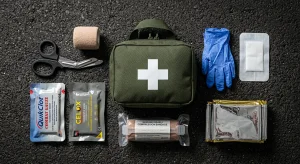
1. Essential Wound Care
Trail tumbles are rarely as clean as a pavement scrape. Dirt, grit, small stones, and vegetation can complicate even basic wound care when a sink is hours away.
- Sterile gauze pads: Indispensable for covering larger scrapes and minor cuts.
- Adhesive bandages: Pack various sizes for smaller cuts and abrasions.
- Non-adherent dressings: Ideal for coverage where you don't want the dressing sticking to the wound itself.
- Medical tape: Secures dressings and handles other basic first aid needs.
- Self-adherent wrap: A lightweight way to hold dressings in place without relying solely on adhesive.
- Nitrile gloves: A simple, critical barrier for both self-care and assisting another runner.
- Clean water or sterile saline: For basic wound irrigation when appropriate.
For anything more severe—think deep wounds, uncontrolled bleeding, embedded objects, suspected fractures, or injuries that truly impair your ability to move safely—your focus shifts immediately from finishing the race to securing professional medical attention.
2. Blister Management
Ask almost any ultrarunner what can derail a race faster than anything else, and blisters will inevitably rank near the top.
A streamlined trail running first aid kit often includes:
- Blister pads or hydrocolloid dressings
- Sports or medical tape
- Small squares of moleskin or similar friction-reducing material
- Alcohol-free cleaning wipes (optional, depending on your kit preferences)
The smartest strategy remains prevention. Test your socks, shoes, insoles, lubrication, and taping methods rigorously during training. Mile 35 of a race is not the time for an untested experiment.
3. Emergency Warmth and Weather Protection
One of the starkest contrasts between road running and remote trail running is how rapidly conditions can change.
An injured runner who stops moving can lose body heat far more quickly than someone actively running.
Depending on the race and environment, consider packing:
- An emergency blanket
- A lightweight rain shell
- An additional layer, if required or strongly advised by the race
- Sun protection for exposed stretches
Mountain weather demands particular respect. A sunny, warm morning at the start doesn't guarantee pleasant conditions several hours later at higher altitudes.
4. Signaling and Navigation
Your backcountry running safety plan extends beyond simple bandages.
Sometimes, the most important action after an injury is making yourself easier to find.
Key items include:
- Emergency whistle
- Fully charged phone
- Offline map or dedicated navigation device
- Headlamp with ample battery life
- Emergency contact information
- A satellite communication device for truly remote routes, when appropriate
Never assume cell service will be available just because you had bars at the trailhead.
5. Personal Medications
Personal medications are, by definition, personal.
If you take prescription medication or manage a known medical condition, plan diligently and adhere strictly to your healthcare provider's guidance.
For instance, runners prescribed an epinephrine auto-injector for severe allergic reactions should carry it as per their personal emergency plan, rather than relying solely on general over-the-counter allergy remedies.
Medication decisions during an ultramarathon demand extra caution. Extended endurance efforts place unusual stress on the body. Avoid introducing unfamiliar medications or altering your standard routine on race day without proper medical consultation.
Trauma Gear: Is It Necessary for Ultrarunners?
Here's where the answer becomes nuanced: it depends.
A standard ultramarathon first aid kit and a specialized trauma kit are not necessarily interchangeable.
For many runners, prioritizing basic wound care, blister management, emergency warmth, signaling, and personal medications offers the most practical advantage.
More isolated routes, unsupported ventures, or higher-risk environments might indeed warrant additional emergency equipment. However, specialized trauma supplies are most effective when the carrier also possesses the training and knowledge to deploy them correctly.
Instead of asking, "What's the largest medical kit I can possibly carry?" ask:
What are the genuine risks on this particular course? How far am I from assistance? And what equipment do I actually know how to use proficiently?
This approach leads to far more effective trail running emergency supplies.
Hydration and Electrolytes: Stick to Your Tested Plan
Hydration during an ultramarathon is profoundly individual. Weather, pace, sweat rate, altitude, race duration, and personal physiology all play a role.
The middle of a race is absolutely the wrong time to experiment with a completely new hydration strategy.
Rely on a plan you've honed during extensive training, heed race guidelines, listen closely to your body's signals, and resist the urge to overhydrate simply because you feel obligated to drink on a rigid schedule.
Electrolyte products or oral rehydration solutions can have a place in some runners' plans, but they are not a universal panacea for every symptom encountered during an endurance event.
Don't Overlook Aid Stations
Carrying your own ultramarathon first aid kit doesn't negate the value of professional race support.
Before race day, make sure you understand:
- Aid station locations
- Which stations are staffed with medical personnel
- All mandatory safety equipment requirements for the race
- How to contact race officials in an emergency
- Evacuation points, if that information is provided
Your personal kit exists to bridge the gap between checkpoints, not to replace qualified medical professionals.
Keep Your First Aid Kit within Reach
A perfectly organized kit is useless if it's buried under six hours'