Backstage: It moves to its own chaotic beat.
Actors wrestle with quick changes. The props team, in a frantic ballet, scours for that one item that just evaporated. Technicians, contorted like pretzels, navigate a spaghetti-tangle of cables to tweak a light, all while the stage manager, ever-present, watches the clock, a familiar call hanging in the air:
“Places, everyone!”
From the comfort of the audience, it’s a seamless, almost magical, operation.
Behind the curtain? That’s a different story. One misplaced extension cord can write a plot twist nobody asked for, bringing the entire production to an unexpected halt.
A foot catches a cable. A hand snags on a rough edge of scenery. Someone finishes moving a flat, only to discover a finger has unilaterally decided:
“Nope. I’m out.”
This is precisely why every production—from professional houses to community theater, to school plays—must have a clearly marked theater first aid kit. It’s the peace of mind for the inevitable cuts, scrapes, blisters, and bumps that come with the territory, rehearsal after rehearsal, show after show.
Backstage Is Mayhem. Your First Aid Kit’s Location Shouldn’t Be.
Backstage spaces are a constantly shifting puzzle: cramped, often poorly lit, and always in flux.
Costume racks migrate.
Props disappear and reappear.
Set pieces certainly have a mind of their own.
Your first aid kit should not join this wandering circus.
If your backstage first aid kit is in the dressing room today and under the soundboard tomorrow, that critical moment of need will instantly devolve into:
“Wait… where did the first aid kit go?”
Suddenly, the entire crew is engaged in an involuntary scavenger hunt, and the prize is decidedly not worth the effort.
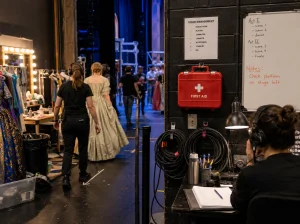
The solution is simple: a single, fixed, visible, and easily accessible spot. Think near the stage manager’s station, or another designated, unmistakable backstage hub.
The stage manager, the tech crew, teachers, and all responsible staff must know its exact whereabouts. Not just “somewhere backstage.”
More like, “on the wall, to the left of the stage manager’s desk.”
What Belongs in a Theater First Aid Kit?
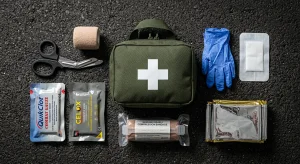
A functional first aid kit for theater environments should contain basic, yet effective, supplies:
- Assorted adhesive bandages
- Cleansing or antiseptic wipes
- Sterile gauze pads
- First aid tape
- Disposable gloves
- Instant cold packs
- A straightforward first aid guide
Keep in mind, different departments face different hazards.
The costume team might contend with minor needle pricks, chafing, or small nicks during frantic quick changes. The tech crew, on the other hand, navigates tools, cables, sharp metal edges, heavy lighting rigs, and cumbersome scenery.
This means your stage crew safety supplies need to be organized, clearly compartmentalized, and grab-and-go ready.
The objective isn’t to cram the kit until the zipper threatens mutiny.
The objective is to open it and immediately locate what you need.
Because five minutes before curtain, nobody wants to upend the entire kit onto a table, muttering:
“I know the bandages are in here… somewhere.”
School Plays: Don’t Skip the Prep
A school production might lack the grandeur of a Broadway show, but the backstage environment remains a high-energy zone filled with extension cords, props, lighting, costume changes, moving scenery, and marathon rehearsals.
And when students get swept up in the excitement, their backstage navigation speed can escalate to:
“Full sprint, minimal observation.”
That’s precisely why school play first aid supplies must be assembled and checked well before opening night, not hastily thrown together in the eleventh hour.
A teacher, stage manager, school nurse, or designated staff member should take ownership: regularly inspecting the kit, replacing used items, and ensuring everyone understands who to contact for anything beyond minor bumps and scrapes.
This beats asking the entire cast, ten minutes to curtain:
“Did anyone bring a Band-Aid?”
Before Rehearsals and Performances: A Quick Check
A first aid kit can sit silently backstage for months, a patient sentinel. But silence doesn't mean perpetual readiness.
Before any significant rehearsal period or performance run, confirm the following:
- Are frequently used supplies still in stock?
- Are individual packages sealed and intact?
- Have all expired items been replaced?
- Is the kit clearly labeled and easy to open?
- Do all responsible staff members still know its precise location?
If someone uses the last cold pack or depletes the bandage supply, restock immediately.
That empty compartment won’t magically refill itself between Act One and Act Two.
A Backstage Kit Isn’t a Substitute for Professional Medical Care
A performing arts emergency kit is designed for routine, minor incidents. It does not, under any circumstances, replace trained first aid personnel, established emergency protocols, or professional medical attention.
For severe bleeding, head injuries, breathing difficulties, serious allergic reactions, loss of consciousness, or any other concerning condition, cease activity immediately and seek appropriate professional medical help.
“The show must go on” is a cherished theatrical maxim.
It is not a medical directive.
Ultimately, good backstage preparation shouldn’t become a production in itself:
Designate one fixed location.
Use clear, unambiguous signage.
Inspect and restock regularly.
Ensure all key staff know its exact spot.
Let the performance deliver all the unexpected twists and turns. The location of your theater first aid kit? That should be utterly predictable.
FAQ
Q1: Where should a theater first aid kit be kept?
A theater first aid kit needs a fixed, visible, and easily accessible backstage location. The stage manager’s station or another clearly identified staff area often serves as a practical choice.
Q2: What basic supplies should a backstage first aid kit contain?
A basic backstage first aid kit should include adhesive bandages, cleansing wipes, sterile gauze, first aid tape, disposable gloves, instant cold packs, and a basic first aid guide. Specific contents may vary based on the production and venue.
Q3: Does a school play need its own first aid supplies?
Absolutely. School productions still involve cables, lighting, costume changes, props, and moving scenery. Preparing school play first aid supplies in advance allows staff to address minor backstage incidents promptly, avoiding last-minute scrambling.
Q4: Who should check and restock the theater first aid kit?
The stage manager, venue manager, a teacher, school nurse, or another assigned staff member should be responsible for checking the kit before rehearsals and performances, ensuring used, damaged, or expired items are replaced.
Q5: Can a performing arts emergency kit handle every injury?
No. A performing arts emergency kit is designed for minor, everyday incidents. Any serious or concerning injury requires immediate attention from trained medical professionals.