Vehicle First Aid Kits: Tactical Field Guide to Red Cross Standards and Fleet Readiness
Pop open a factory glovebox and you will likely find an owner’s manual, an expired registration card, and zero medical gear. That is a massive liability. Whether managing a long-haul commercial fleet, outfitting an overland rig, or driving a daily commuter sedan, basic adhesive bandages fall short when a blowout strikes at highway speed.
The American Red Cross establishes baseline guidelines for mobile medical care. Yet extreme cabin heat, relentless road vibration, and delayed rural EMS response demand a far more rugged specification. Here is how to assemble a heavy-duty vehicle trauma kit built for real-world roadside emergencies.

Baseline Standards vs. Real-World Roadway Hazards
Federal Motor Carrier Safety Administration (FMCSA) 49 CFR 393.93 mandates emergency equipment in commercial power units, while OSHA 1910.151 applies workplace safety rules to any employee-driven vehicle. If a worker drives on the job, that cab is a work site. The baseline framework follows ANSI/ISEA Z308.1-2021.
Standard retail kits handle minor scrapes. A serious roadside kit prepares drivers for high-impact trauma: vehicle entrapment, severe crush injuries, arterial bleeding, hypothermia, and prolonged waits on remote shoulders.
Red Cross guidelines segment mobile medical gear into three distinct operational tiers:
- Personal Commuter (40–46 Piece Baseline): Geared for minor lacerations, light thermal burns, and basic CPR barrier protection.
- Extended Travel / Utility (93–137 Piece Standard): Adds orthopedic support, heavy-duty trauma shears, multi-size pressure dressings, and basic diagnostic tools.
- Commercial & RV Outfitting (ANSI Class B + Trauma Additions): Built for high-occupancy vehicles, hazmat haulers, and remote routes where EMS response exceeds 30 minutes.
The Core Vehicle Emergency Kit Inventory
Throwing loose supplies into a flimsy pouch is not emergency prep. In high-stress scenarios, organization dictates survival speed. If you cannot grab a tourniquet or pressure dressing within ten seconds in total darkness, the kit fails.
Every field-ready auto kit requires these standard components:
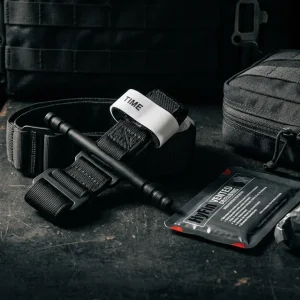
Trauma & Hemorrhage Control: Roller gauze, 4x4 sterile pads, at least two triangular bandages, and heavy trauma pads. For fleet drivers working near live traffic, add a CoTCCC-approved windlass tourniquet and hemostatic gauze.
Airway & Barrier Protection: CPR face shield with a one-way valve, non-latex nitrile gloves (minimum 4 pairs, size XL to slip over dirty work gloves), and antiseptic cleansers.
Topicals & Meds: Triple antibiotic ointment, hydrocortisone gel, burn relief dressing, diphenhydramine (antihistamine), ibuprofen, and an isotonic eye wash (minimum 4 oz bottle).
Tools & Field Diagnostics: Medical-grade trauma shears (capable of slicing through seatbelts and heavy denim), stainless steel tweezers, a high-lumen penlight, a 36-inch aluminum splint (such as a SAM splint), and industrial-grade cloth medical tape.

Heavy Vehicle Outfitting: RV and Commercial Fleet Specifications
Outfitting a Class A motorhome or commercial rig requires a different approach than stocking a hatchback. Larger chassis carry more passengers, travel deeper into dead zones, and introduce severe mechanical and electrical hazards.
For RVs and heavy fleets, bypass basic Class A setups in favor of a Class A/B Hybrid kit. Stock expanded 8x10-inch burn dressings, chest seals, multiple SAM splints for fracture stabilization, and extra eye wash bottles. Because RV living quarters carry distinct fire risks from onboard propane systems, pair your fire extinguisher with water-based hydrogel burn blankets.
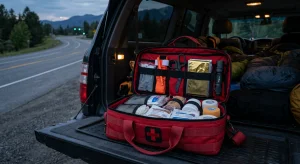
Fleet operators need a strict inspection cycle. Constant engine vibration destroys flimsy plastic packaging, while heat bakes liquid topicals. Skip cheap zippered pouches and mount hard-shell polypropylene cases or 1000D ballistic nylon MOLLE pouches directly to cab bulkheads.
Sub-Zero Readiness: Winter Survival Additions
Cold weather accelerates shock. When a vehicle loses power in sub-zero temperatures, hypothermia sets in quickly—especially for an injured driver who cannot move. Winter demands specialized gear beyond a standard medical checklist.
Integrate these cold-weather survival items directly alongside your primary medical kit:
- Thermal Management: Dual Mylar space blankets paired with a heavy-duty wool or synthetic rescue blanket.
- Auxiliary Power & Illumination: A hand-crank weather alert radio featuring solar charging, an integrated LED spotlight, and a high-output USB port for dead phones.
- Traction & Signalling: A collapsible aluminum snow shovel, an ANSI Class 2 reflective safety vest, and chemical hand/torso heat packs.
- Caloric Support & Hydration: Freeze-tolerant, high-density emergency food bars and a stainless steel cup capable of melting snow over an open flame.
Alkaline batteries leak, drain, and fail in freezing temperatures. Replace them with lithium-cell headlamps or hand-crank lighting units inside your emergency kit.
Deployment & Storage: Battling Extreme Cabin Temps
Burying medical gear beneath a spare tire guarantees delay when seconds count. Likewise, tossing a pouch on the rear dash bakes nitrile gloves and adhesive backings under direct UV rays.
Cabin temperatures routinely surge past 140°F in summer and drop below freezing in winter. Extreme thermal swings turn adhesive tape into unusable goo, dry out hydrogel burn pads, and make nitrile gloves brittle enough to snap on application. Store your kit inside the climate-controlled cabin whenever possible—anchored under the front passenger seat or secured to an accessible cargo bulkhead.
Audit your auto emergency kit every six months. Replace expired ointments, verify the sterile seals on trauma dressings, and check elastic bandages for heat degradation.
Frequently Asked Questions
What is the difference between an ANSI Class A and Class B vehicle first aid kit?
Class A kits cover general workplace hazards, providing basic tools for minor cuts, scrapes, and light burns. Class B kits are built for high-risk, high-occupancy, or remote environments, carrying broader supplies—like chest seals, trauma shears, and multiple splints—to manage major trauma when professional medical care is delayed.
How often should you inspect and replenish auto emergency supplies?
Inspect kits every six months. Check expiration dates on topicals, medications, and sterile eye washes. Replace any item with damaged packaging, inspect nitrile gloves for dry rot, and test flashlights or replace depleted batteries.
Does OSHA require a commercial vehicle first aid kit for company cars?
Yes. Under OSHA standard 1910.151, any vehicle used for business operations—whether a corporate sedan, work truck, or personal vehicle driven on company time—is classified as a workplace and must contain adequate medical supplies tailored to route risks.