FDA-Compliant Tactical Medical Gear: Spotting Counterfeits Before Deployment
Substandard trauma gear fails under load. When an artery bursts, a snapped windlass or compromised chest seal adhesive converts a controlled intervention into a casualty. Counterfeits fill the market today—visually identical to real gear, yet structurally hollow when pressure spikes.
Filtering out dangerous knockoffs demands clear sight into federal regulations, true structural tolerances, and rigorous supply chain auditing.
FDA Compliance Myths vs. Regulatory Realities
Procurement bids routinely call for "FDA certified tactical medical equipment." The phrasing is incorrect—and shady vendors exploit it. The U.S. Food and Drug Administration does not issue generic certificates of approval for medical hardware.
Tactical trauma gear fits into clear regulatory tiers based on patient risk:
- Class I Devices: Low-risk goods like trauma shears, elastic wraps, and standard gauze. Manufacturers must register their establishment and list the device, but premarket review is not required.
- Class II Devices: Moderate-to-high-risk gear, including arterial tourniquets, chest seals, and hemostatic dressings. These require 510(k) Premarket Notification, proving the device is substantially equivalent to an existing legally marketed device.
Treat single-page "FDA Registration Certificates" as immediate red flags. Facility registration proves only that a supplier logged their physical address in a database. It guarantees nothing about mechanical strength under field pressure.
How Counterfeit Tourniquets Mechanically Fail
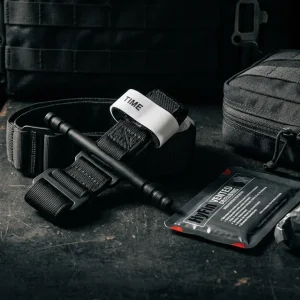
Knockoff windlass tourniquets pose catastrophic supply chain risks. These fake tourniquets mirror authentic units down to molded patent numbers, branding stamps, and packaging details. Beneath the surface, their structural tolerances fail under real work.
Stopping an arterial bleed in a thigh requires circumferential pressure over 300 to 500 mmHg. Real military-grade tourniquets use glass-reinforced composite or machined aluminum windlasses built to handle extreme torque. Fakes use cheap, unreinforced injection-molded plastic.
When torqued tight, knockoffs break down in three predictable patterns:
- Windlass snap: The plastic rod bows or snaps outright on the second or third turn.
- Buckle failure: The friction adapter bar bends under tension, slipping the strap and losing pressure.
- Stitching shear: Structural thread bursts long before reaching target occlusion pressures.
A broken tourniquet forces an operator to start over with fresh gear while arterial blood dumps. Seconds lost in hemorrhage control directly sink survival odds.
Supply Chain Audits for Authentic IFAK Supplies
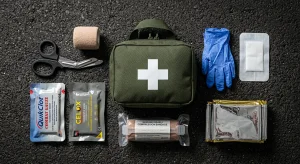
Protecting units with authentic IFAK supplies requires deeper inspection than surface visual checks. Shady distributors often mix knockoffs into authentic lots or move grey-market stock stored in heat-damaged warehouses where adhesives and polymers degrade prematurely.
Run incoming trauma inventory through a strict four-stage audit:
1. Verify 510(k) Clearance Numbers
For hemostatic gauze (kaolin or chitosan variants) and advanced chest seals, demand the vendor's FDA 510(k) number (formatted as "K" plus six digits). Cross-check the number directly in the public FDA 510(k) or AccessGUDID databases.
2. Inspect Packaging and Serialization
Reputable manufacturers print lot numbers, expiration dates, and 2D matrix codes directly onto primary sterile barriers. Fakes often slap paper stickers over lot fields or strip batch control data entirely. Crisp, consistent font is standard; soft or fuzzy print points straight to photo-copied packaging artwork.
3. Require Authorization Proof
Procure directly from primary manufacturers or certified distributors. Request a current, verified Letter of Authorization from the brand owner. Never source life-critical gear from open third-party storefronts where vendor credentials change constantly.
4. Perform Batch Structural Tests
Pull random sample units from every shipment before issuing gear. Check buckles for factory mold marks and clean edges. Test hemostatic gauze packages—soft, unsealed pouches indicate broken sterile barriers and compromised shelf life.
Bridging CoTCCC Guidelines with OSHA and ANSI Frameworks
Federal safety regulations mandate adequate workplace medical supplies. OSHA 1910.151 requires accessible first-aid resources for personnel. But in high-threat tactical, law enforcement, or industrial environments, basic ANSI Z308.1 commercial first-aid kits fall dangerously short during massive trauma events.
Smart procurement upgrades beyond basic compliance by integrating TCCC approved medical gear tested and vetted by the Committee on Tactical Combat Casualty Care.
| Equipment Category | ANSI Z308.1 / Basic Standard | CoTCCC / Advanced Tactical Standard |
|---|---|---|
| Hemorrhage Control | Standard roller gauze & pads | CoTCCC-recommended limb tourniquets & 510(k) cleared hemostatic gauze |
| Airway Management | CPR face shield | Nasopharyngeal Airway (NPA) with surgical lubricant |
| Respiration | Not addressed | Vented chest seals for penetrating thoracic trauma |
| Hypothermia Prevention | Basic foil blanket | Active heating blankets and insulated enclosures |
Selecting gear that satisfies both FDA regulatory status and CoTCCC evaluation criteria guarantees that medical hardware is legally compliant, field-safe, and proven to hold under pressure.
Does the FDA directly approve tourniquets and chest seals?
No. The FDA does not grant formal certificates of approval for Class I or Class II devices. Class II hardware like tourniquets and chest seals receives 510(k) clearance, confirming substantial equivalence to legally marketed devices. Class I items require simple registration and listing. Reject claims of generic FDA certificates of approval.
How can procurement officers spot fake tourniquets before deployment?
Check construction details and chain of custody. Counterfeits routinely feature thin windlasses without reinforcing ribs, sloppy buckle stitching, shiny slick webbing, and missing or malformed lot codes. Always demand a direct Letter of Authorization from the manufacturer before placing orders.
What is the difference between CoTCCC recommended gear and FDA registered gear?
FDA clearance addresses legal distribution, safety baselines, and manufacturing standards in the U.S. CoTCCC (Committee on Tactical Combat Casualty Care) recommendations evaluate battlefield performance—proving a device actually stops arterial bleeds under harsh operational conditions. High-threat kits need both regulatory compliance and CoTCCC backing.