There's nothing quite like it: finally nailing that trick you’ve been battling all afternoon.
The board sticks to your feet. The landing? Clean. And then, from somewhere nearby, you hear it:
“That was sick.”
Then, of course, there are the other attempts.
Board goes one way, you go the other. Concrete, an ever-present force, delivers an immediate, blunt reminder:
“Hey, remember me?”
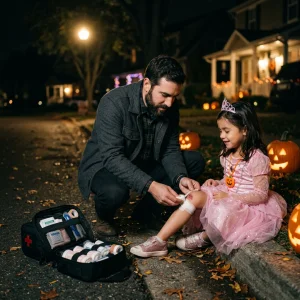
Minor scrapes, bruised elbows, bumped knees, and small cuts—these are the standard costs of a session. That’s precisely why a compact skateboarding first aid kit isn't just a good idea for skateboarders; it's smart for longboard riders, inline skaters, and roller skaters, too.
This isn't about bracing for disaster every time you roll out. It’s about avoiding that moment someone needs a bandage, and all your backpack offers are headphones, a charging cable, and a thoroughly crushed bag of chips.
Your Personal Kit: If It’s Too Big, You Won’t Bring It
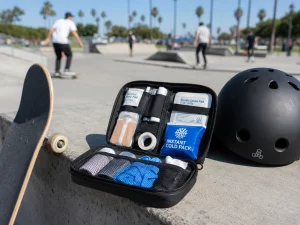
A personal first aid kit for skateboarders doesn’t need to be massive.
You’re heading to the skate park, not opening a mobile urgent care clinic next to the half-pipe.
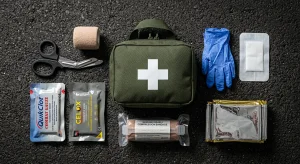
A slim kit focuses on the essentials: minor scrapes, small cuts, and everyday bumps. Depending on the rider and the session’s duration, it might include:
- Assorted adhesive bandages
- Cleansing or antiseptic wipes
- Sterile gauze pads
- First aid tape
- Disposable gloves
- A small instant cold pack
The most effective kit usually slides seamlessly into a backpack, tucks into a car compartment, or fits in a gear bag without hogging all the space.
If your kit is so cumbersome you consistently leave it home, it’s not exactly winning any portability awards.
Road Rash Supplies: No Scavenger Hunt Required
Hands, knees, and elbows often meet the ground first in a fall. Basic first aid supplies for road rash can provide immediate cleaning and temporary coverage for those minor surface scrapes.
These supplies need to be organized. Not buried beneath tools, spare wheels, water bottles, and random skate hardware.
Keep your adhesive bandages together. Group gauze and tape in another spot. Stash gloves and cold packs somewhere immediately visible.
The objective is straightforward:
Open the kit.
Spot what you need.
Grab it.
Done.
Nobody who’s just had an unscheduled chat with the pavement feels like playing:
“Which pocket has the gauze?”
A Skate Park Kit: A Different Breed Entirely
A rider’s personal kit serves individual needs. A larger skate park first aid kit, however, must cater to the facility itself, its staff, and all its visitors.
This park kit might contain larger quantities of bandages, gauze, gloves, cold packs, and other fundamental supplies, scaled to the park’s size and activity level.
Crucially, it needs a permanent, clearly marked storage location.
If the kit is at the front desk on Monday, inside a maintenance closet on Tuesday, and then vanishes under cleaning supplies by Friday, it becomes:
“Technically available, practically non-existent.”
Staff members must know precisely where it’s kept, who’s responsible for checking its contents, and when depleted or expired supplies require replacement.
Bandages, after all, don’t quietly restock themselves after closing time.
Clarity Over Sheer Volume
A practical portable sports first aid kit prioritizes easy identification and access for frequently used items.
Transparent pouches, mesh pockets, or simple labeled sections help keep smaller items separate. Individually wrapped supplies should remain sealed until needed; damaged or wet packages require prompt replacement.
A kit crammed with hundreds of items isn't inherently useful if everything’s jumbled and nobody can locate a thing.
More supplies can be helpful.
More chaos?
Absolutely not.
For individual riders, a smaller, meticulously organized kit often proves far more practical than an oversized bag that simply gets left in the car because it's too much of a hassle to carry.
Protective Gear and First Aid: Different Jobs, Equal Importance
Helmets, wrist guards, knee pads, and elbow pads remain foundational skateboarding safety essentials.
Protective equipment mitigates risk before an incident occurs. A first aid kit, conversely, provides basic support once a minor issue has already surfaced.
One does not substitute for the other.
A bag full of adhesive bandages does not suddenly make riding without proper protective gear a brilliant strategy.
That’s not confidence.
That’s placing far too much blind faith in concrete.
Know When It’s Time to Call It
A basic kit addresses minor cuts, surface scrapes, and small bumps. It is not, however, designed to diagnose injuries or replace professional medical attention.
After a significant fall, a head impact, severe or lingering pain, notable swelling, difficulty standing, or restricted movement, the rider must stop skating and seek appropriate help.
“One more try” is classic skate park mantra.
But when something genuinely feels wrong, perhaps that trick can wait for another day.
The board will still be there.
Ultimately, a truly useful skateboarding first aid kit should be:
- Compact enough to actually carry
- Clearly organized
- Stocked with essential basic supplies
- Easy to find near the skate area
- Consistently checked and restocked
Because landing a trick might take several attempts.
Finding a bandage, though, really shouldn't.
FAQ
Q1:What should a skateboarding first aid kit contain?
A basic skateboarding first aid kit typically includes adhesive bandages, cleansing wipes, sterile gauze, first aid tape, disposable gloves, and a small instant cold pack. Adjust contents based on rider count and session length.
Q2:Do skateboarders need to carry a large first aid kit?
Generally, no. A personal first aid kit for skateboarders should be compact, lightweight, and easily portable in a backpack, gear bag, or vehicle.
Q3:Should a skate park have its own first aid kit?
Yes. A skate park first aid kit must be kept in a fixed, clearly marked location and regularly inspected by designated staff members.
Q4:Can a first aid kit replace helmets and protective pads?
Absolutely not. Helmets, wrist guards, knee pads, and elbow pads are preventive skateboarding safety essentials. A first aid kit provides basic support after a minor incident has already occurred.
Q5:What supplies are useful for minor road rash?
Basic first aid supplies for road rash may include cleansing wipes, sterile gauze, adhesive bandages, first aid tape, and disposable gloves. More serious or concerning injuries require professional medical evaluation.
Q6:When should a rider stop skating after a fall?
A rider should stop after any head impact, severe or persistent pain, significant swelling, difficulty standing, limited movement, or any other symptom causing concern. A portable sports first aid kit is not a substitute for professional assessment of a potentially serious injury.