You’re organizing your first aid kit. Cardboard boxes, plastic wrappers, individual packets—it’s a lot.
“What if I just strip all this down?” you think. “Make some real room?”
On paper, it sounds smart.
The bag slims down, the zipper glides smoothly for once, and suddenly, you can stash a few more bandages.
But before you start unwrapping those first aid supplies, stop. There’s a critical detail you might be overlooking:
That packaging isn't just dead weight.
It’s doing a job.
That Original Packaging Does More Than Just Contain
Original medical packaging often holds critical information that vanishes once the wrapper is gone. Trying to recall it later? Nearly impossible.
Depending on the item, that humble wrapper might display:
- The product name and its intended application
- Size or quantity specifics
- The all-important expiration date
- Directions for use and crucial safety warnings
- Lot or batch numbers for traceability
- Confirmation of the original seal’s integrity
Beyond information, the sealed wrapper also serves as a visual cue. It instantly tells you if an item has been tampered with, exposed to moisture, or compromised during storage.
Imagine this: a handful of white gauze pads, all removed from their wrappers and tossed into a generic plastic bag. The scenario quickly devolves into:
“Is this sterile gauze?”
“...Probably?”
“When does it expire?”
“Excellent question, one I cannot answer.”
That’s precisely the problem.
Before you remove any packaging, ask yourself: Will I still be able to identify this item, verify its expiration date, follow its instructions, and confirm its pristine, sealed condition?
Outer Cardboard Boxes: Sometimes Optional
Some first aid products arrive in a larger cardboard box, but each individual item within is already sealed and clearly labeled.
In cases like these, discarding the bulky outer box can be a perfectly sensible way to achieve first aid kit space-saving.
However, don't just toss important details along with the cardboard. Before it hits the recycling bin, consider cutting out or noting down:
- The product name
- The expiration date
- The lot or batch number
- Any vital directions or warnings
You can snip the information panel right off the box, keep the instruction leaflet, or simply place a clearly labeled note inside your kit.
The rule is simple:
That big outer box? Negotiable.
The sealed individual wrapper?
Hands off.
Never Unwrap Sterile Supplies Just to Save Space
Sterile gauze, dressings, and many adhesive bandages rely entirely on their intact packaging to maintain their sterile condition.
Pulling individually wrapped first aid supplies out and lumping them into a common resealable bag does not magically transfer that original sterile seal to the new container.
Does it look tidier?
Absolutely.
Can you still confirm everything is sterile and properly protected?
That's where the awkward silence begins.
A standard plastic bag might help organize, but it’s no substitute for manufacturer-sealed medical packaging.
Furthermore, if an individual wrapper is already torn, open, wet, or damaged, moving that item into a fresh bag doesn't somehow reset its condition.
The new bag can’t just proclaim:
“Relax, we're sterile again.”
That’s not how medical integrity works.
What About Adhesive Bandages and Cleansing Wipes?
Adhesive bandages stay cleaner and better protected within their individual wrappers. Removing them prematurely exposes the adhesive pad and dressing area to dust, moisture, skin oils, and general handling, all of which compromise their effectiveness.
Cleansing and antiseptic wipes likewise need to stay sealed. Their foil or plastic packets are designed to keep the liquid active and prevent contamination until the moment of use.
Once a wipe packet is opened, it often begins to dry out almost immediately.
And a dry antiseptic wipe? Essentially, it’s just a tiny square of profound disappointment.
You Can Repack Without Unwrapping
To repack your first aid kit effectively, you don't need to strip every item naked.
Instead, keep each item sealed and simply group similar supplies together.
For instance:
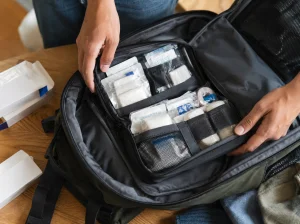
- Place all wrapped adhesive bandages into one clear pouch.
- Keep all sealed wipes in another designated section.
- Store packaged gauze and dressings as a unit.
- Separate tape, gloves, and larger items into their own areas.
This method ensures items are easy to find while fully preserving their labels, expiration dates, and critical seals.
Another tactic: remove duplicate supplies you genuinely don’t need, rather than forcing the zipper into a losing battle with twenty superfluous packets.
A first aid kit isn't a suitcase-packing competition.
Squeezing in five extra gauze pads offers little benefit if no one knows what they are or if they’re still safe to use.
Technically efficient? Perhaps.
Practically sound? Highly questionable.
When Is Storing Supplies Without Packaging Acceptable?
Whether you can store first aid supplies without packaging depends entirely on the item.
Durable, non-sterile tools like scissors or tweezers typically don’t require disposable individual packaging, though they absolutely must be kept clean and protected.
However, products whose efficacy hinges on a sterile seal, a moisture barrier, an expiration label, or printed instructions should invariably remain in their original wrappers.
When in doubt, always defer to the manufacturer’s storage instructions.
The safest overall strategy is straightforward:
Ditch unnecessary outer boxes.
Keep individual sealed packaging intact.
Preserve all vital product information.
Replace anything with compromised packaging.
Because when a real emergency strikes, you need a clearly labeled, properly sealed item you can trust.
Not a mystery square of white material that forces you to ponder:
“Okay, but what exactly are you?”
FAQ
Q1: Can I remove adhesive bandages from their individual wrappers?
It's best practice to keep adhesive bandages in their individual wrappers. Removing them prematurely exposes them to dust, moisture, handling, and other elements that can compromise their cleanliness or adhesive performance.
Q2: Can I throw away the outer cardboard box?
If the supplies inside are individually sealed and clearly labeled, you can often remove the bulky outer box to save space in your first aid kit. Just be sure to retain the expiration date, product name, lot information, directions, and any critical warnings.
Q3: Can sterile gauze be stored in a regular resealable bag?
While a regular resealable bag can help organize, it cannot replicate the sterile environment of the original packaging. Unopened sterile gauze must remain sealed in its manufacturer-provided wrapper.
Q4: How can I save space without removing individual packaging?
Remove unnecessary outer boxes, group sealed items into clear pouches, eliminate duplicate supplies, and maximize your kit’s compartments. This allows you to repack your first aid supplies without compromising labels or seals.
Q5: Should I keep a first aid item if its packaging is damaged?
If the seal is torn, open, wet, or otherwise compromised—especially for a sterile product—always consult the manufacturer’s instructions. When condition cannot be confirmed, it’s safest to replace the item.
Q6: Which supplies can usually be stored without disposable packaging?
Durable, non-sterile tools like scissors or tweezers can often be stored without disposable wrappers, provided they are kept clean and protected. However, items relying on sterility, moisture control, expiration labeling, or printed instructions should always remain in their original medical packaging.