First Aid for Professional Kitchens
Legal Obligation: Readiness, Not Just Best Practice
In any professional kitchen—whether a bustling restaurant or a public sector canteen—cuts, burns, and slips are not just possibilities; they are almost certainties. What distinguishes a well-managed operation from a negligent one is not the prevention of every single incident (an impossible feat), but rather how quickly and effectively injuries are addressed. Proper first aid is not merely a convenience; in the UK, it's a non-negotiable legal obligation. The Health and Safety (First-Aid) Regulations 1981 explicitly mandate employers to provide appropriate first aid equipment and trained personnel. The specifics are determined by a thorough first aid needs assessment, which meticulously accounts for your kitchen's unique hazards and staff numbers. While personal medications are, naturally, outside this scope, many establishments find that aligning with BS 8599-1 provides a robust, compliant framework for their restaurant first aid kit.
Inside the Kit: Essentials for Every Commercial Kitchen
Your commercial kitchen first aid kit must directly address the realities of daily kitchen life: cuts, burns, and the paramount need for hygiene. This isn't about guesswork; it's about stocking exactly what you will use, when you will use it.
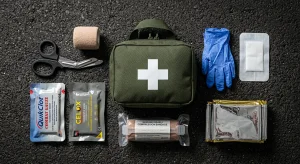
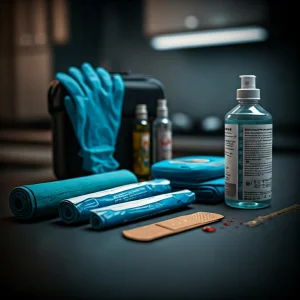
- Wound Management: Start with sterile plasters, but not just any kind. You need blue detectable plasters. Why blue? Because metal detectors in food environments will pick them up. Medium and large sterile dressings are next, followed by finger dressings for those inevitable nicks. And do not forget adhesive tape to secure everything in place.
- Burn Treatment: Burns are a constant threat. Be ready with burn gels or specialized dressings. Quick treatment is paramount.
- Hygiene & Protection: Cleansing wipes are a must. Disposable nitrile or latex-free gloves protect both the injured and the first aider. Eyewash pods are essential for splashes. Infection prevention is not just a best practice; it is a lifeline.
- Emergency Preparedness: Foil blankets can prevent shock in more serious situations. Resuscitation face shields are also critical.
A kit is only effective if it is ready. That means regular checks and immediate replenishment. An empty or expired kit is not just unhelpful; it is a direct safety failure waiting to happen.
FAQ
Why are blue detectable plasters mandatory in food settings?
Blue detectable plasters contain a hidden ferrous strip, making them visible to the metal detection systems routinely used in food production lines. Beyond that, their distinct blue color immediately signals their presence if they somehow fall into food, drastically minimizing the risk of foreign object contamination. Standard, flesh-toned plasters simply do not offer this crucial layer of protection.
What are the legal requirements for a commercial kitchen first aid kit in the UK?
Under the Health and Safety Regulations 1981, employers are legally obligated to provide adequate first aid facilities. For a commercial kitchen, this translates to a detailed needs assessment that specifically addresses risks like sharp knives, hot surfaces, and heavy equipment. The kit itself must be readily accessible. Adhering to BS 8599-1 standards is highly recommended, as it ensures your kit is both comprehensive and fully compliant.
How often should a restaurant first aid kit be inspected?
Your workplace first aid UK kit demands monthly inspection. This is not a quick glance; it is a thorough check of every item for its presence, condition, and expiry date. Any used or out-of-date components must be replaced immediately. This ongoing maintenance should be managed by a designated first aider or a responsible staff member to guarantee continuous readiness.