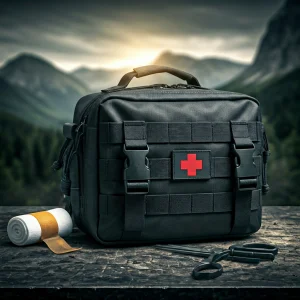
Quick Answer: What's Inside an IFAK
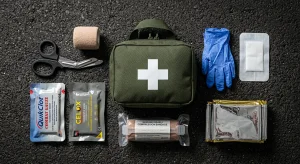
An Individual First Aid Kit (IFAK) focuses on stopping the fastest killers: massive hemorrhage, airway obstruction, and hypothermia. A properly stocked IFAK includes, at minimum:
- 1 Israeli-style pressure bandage (4" or 6") — for wound compression
- 1–2 hemostatic gauze rolls (e.g., Combat Gauze, QuikClot) — for deep wound clotting
- 1 chest seal, vented (e.g., HyFin Vent twin-pack) — for penetrating chest trauma
- 1 nasopharyngeal airway (NPA), 28 Fr, with lubricant — for airway management
- 1 emergency/space blanket — prevents hypothermia
- 1 pair nitrile gloves (minimum 2 pairs) — protects rescuer, prevents cross-contamination
- 1 pair trauma shears — cuts clothing/straps to expose wounds
- 1 permanent marker — records tourniquet application time
- 1 compressed gauze roll (non-hemostatic) — for packing shallow wounds
- 1 chemical hand warmer (optional) — aids hypothermia management
- 1 zip-tie or MOLLE pouch to mount to belt/plate carrier — ensures quick access
This list follows the MARCH framework (Massive hemorrhage, Airway, Respiration, Circulation, Hypothermia) from Tactical Combat Casualty Care (TCCC) protocols. Below, each category explains not just what to buy, but why it's included and how to use it.
The IFAK: Essential in Hostile Environments
The IFAK (Individual First Aid Kit) is often misidentified as military-only gear. It's a tactical medical kit built for one purpose: stabilizing a casualty with immediate, life-threatening injuries before professional medical help arrives. It does not replace a general first aid kit for minor cuts or headaches. It's a survival tool, with contents chosen for that role.
"Military" describes the rigorous design standard behind an IFAK, not its user base. Hunters, law enforcement, correctional officers, overlanders, and search-and-rescue volunteers all rely on the same core equipment. The physiology of a life-threatening bleed remains constant, regardless of occupation.
IFAK Contents Explained by Category (MARCH Framework)
1. Massive Hemorrhage Control
Uncontrolled arterial bleeding can be fatal in 3–5 minutes. This makes hemorrhage control items top priority in every IFAK and TCCC protocol.
- Tourniquet. Only tourniquets on the Committee on Tactical Combat Casualty Care (CoTCCC) recommended device list are reliable for severe bleeds. Generic or uncertified tourniquets have failed independent testing. Practice one-handed self-application; you might only have one functional arm during an emergency.
- Pressure/compression bandage (Israeli bandage, 4" for limbs, 6" for larger wounds). Applies direct, continuous pressure without manual holding, freeing the rescuer's hands.
- Hemostatic gauze (Combat Gauze, QuikClot Combat Gauze, Celox Rapid). Impregnated with a clotting agent, used to pack deep or junctional wounds (groin, armpit, neck) where a tourniquet is unsuitable.
- Compressed/plain gauze roll. For wound packing when hemostatic agents aren't necessary, or as a backup.
2. Airway
- Nasopharyngeal airway (NPA), 28 Fr with water-based lubricant. Maintains an open airway for an unconscious, breathing casualty. Proper placement requires basic training; it's not intuitive.
3. Respiration
- Vented chest seal (HyFin Vent, Bolin Chest Seal), ideally in pairs. Applied over penetrating chest wounds to prevent air from entering the pleural cavity and causing a tension pneumothorax. The vented design allows trapped air to exit while blocking outside air. Both entry and exit wounds need sealing, so kits should include two.
4. Circulation / Wound Care
- Trauma shears. Quickly cut through clothing, boots, or seatbelts to expose and assess injuries without causing further trauma.
- Nitrile gloves, minimum two pairs. A single pair can tear or become contaminated; a second pair ensures rescuer protection throughout the intervention.
5. Hypothermia Prevention
- Emergency/space blanket. Trauma patients rapidly lose body temperature, and hypothermia worsens bleeding by impairing clotting. Untrained responders often overlook this step, but it's critical.
- Chemical hand/body warmers (optional but recommended in cold climates).
6. Documentation
- Permanent marker. Used to mark the tourniquet application time directly on the casualty's skin or the tourniquet itself. This single piece of data significantly influences treatment decisions for subsequent medical teams; tourniquet time exceeding approximately two hours affects limb-viability calculations.
IFAK vs. Standard First Aid Kit: The Distinction
A typical first aid kit handles comfort and minor injuries—band-aids, antiseptic wipes, pain relievers. An IFAK addresses a different question entirely: what causes death in the first ten minutes, and how do you buy time until EMS or higher-level care arrives?
This is the core principle behind every item listed: treat first what kills first. Nothing in a properly assembled IFAK is there for convenience. Each item earns its place by addressing a specific, time-critical failure mode—bleeding, airway obstruction, chest trauma, or heat loss.
Who Needs an IFAK?
Its use case is broader than many assume. Anyone operating where EMS response times exceed the window in which a serious injury becomes fatal should carry one. This includes:
- Hunters and backcountry hikers (remote terrain, no cell signal)
- Search and rescue volunteers
- Law enforcement and corrections officers
- Motorsports and extreme sports participants
- Range officers and firearms instructors
- Remote/industrial workers (construction, oil & gas, forestry)
- Overlanders and long-distance travelers
The common thread in all these settings isn't the activity, but the distance from definitive medical care.
IFAK Placement
Placement determines a kit's utility. An IFAK in a car trunk or home medicine cabinet is useless when needed most—severe hemorrhage kills in minutes, not in the time it takes to retrieve a kit from a vehicle.
The kit should be:
- On the body (belt-mounted, thigh rig, or plate carrier)
- Or on immediately accessible gear (e.g., the top compartment of an actively worn daypack, not stored in a trunk)
If retrieving the kit takes more than a few seconds, its placement needs adjustment.
Training: Equipment Isn't Enough
Owning the right gear is only half the battle. Incorrectly applying a tourniquet, misplacing a chest seal, or missing a junctional wound can cost precious time or worsen the outcome. Civilian trauma response often faces this documented limitation: unpracticed hands under stress hesitate or use improper techniques.
Recommended training paths:
- TECC (Tactical Emergency Casualty Care) — the civilian equivalent to TCCC, designed for law enforcement, security, and civilian responders
- Stop the Bleed — a free, widely available course focused on hemorrhage control
- Wilderness First Aid (WFA) or Wilderness First Responder (WFR) — for backcountry and remote access scenarios
Without training, an IFAK is just a bag of gear. With it, it becomes a functional lifeline. Review manufacturers' training materials and the CoTCCC Tactical Combat Casualty Care Guidelines directly, rather than relying solely on secondhand summaries—protocols update regularly as battlefield and civilian trauma data evolve.
FAQ
What is an IFAK?
An IFAK (Individual First Aid Kit) is a specialized first aid kit for life-threatening emergencies, primarily massive hemorrhage, airway compromise, and hypothermia. It contains purpose-specific items like tourniquets, hemostatic gauze, and chest seals, distinguishing it from standard kits for minor injuries.
What are the most important items in an IFAK?
A tourniquet and hemostatic/pressure dressings are highest priority, as uncontrolled bleeding is the leading cause of preventable trauma death. A chest seal and airway adjunct follow closely, addressing the next fastest causes of death.
Is the IFAK only for military personnel?
No. While its design originated in military trauma medicine, an IFAK is relevant for anyone facing significant risk of serious injury far from immediate medical care—hunters, law enforcement, remote workers, and backcountry travelers.
Is training necessary to use an IFAK?
Yes. IFAK components are effective only when applied correctly and quickly. Courses such as TECC, Stop the Bleed, or Wilderness First Aid teach correct technique and intervention prioritization, turning the kit from gear into an actionable tool.
How often should I check or replace IFAK contents?
Hemostatic gauze and some adhesive components have manufacturer expiration dates (typically 3–5 years). Tourniquets should be inspected for UV/material degradation if stored in a vehicle or exposed to sunlight. Check contents at least twice a year.
This article is for informational purposes only and does not replace certified medical training. Always seek qualified instruction (e.g., TECC, Stop the Bleed, WFA/WFR) before relying on any trauma intervention in a real emergency.