Quick Answer: What's Inside a Restaurant First Aid Kit
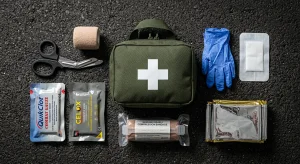
A BS 8599-1:2019 compliant catering first aid kit features blue, metal-detectable contents. This design ensures any item accidentally dropped into food is both visible and machine-detectable. A small kit (for 1–10 staff) typically contains:
| Item | Small Kit (1–10 people) | Medium Kit (11–20 people) |
|---|---|---|
| Blue detectable plasters (waterproof) | 40 | 60 |
| Medium sterile dressings | 4 | 6 |
| Large sterile dressings | 1 | 2 |
| Sterile finger dressings | 2 | 3 |
| Triangular bandages | 2 | 3 |
| Conforming bandage | 1 | 2 |
| Sterile saline/cleansing wipes | 20 | 30 |
| Sterile eye pads | 2 | 3 |
| Hydrogel burn dressing | 1 | 2 |
| Microporous tape | 1 | 1 |
| Nitrile gloves (pairs) | 6 | 9 |
| Safety pins | 6 | 12 |
| Foil (shock) blanket | 1 | 2 |
| Resuscitation face shield | 1 | 1 |
| Scissors | 1 | 1 |
| Guidance leaflet + contents list | 1 | 1 |
Kit contents reflect a typical BS 8599-1:2019-compliant catering kit. Exact quantities may vary slightly between suppliers. Always size your kit based on a documented first aid needs assessment, not just this table.
This guide explains the purpose of each item category, legal requirements versus best practices, and how to properly size a kit for your kitchen.
Legal Requirements for Workplace First Aid (UK)
Under the Health and Safety (First-Aid) Regulations 1981, UK employers must provide "adequate and appropriate" first aid equipment, facilities, and personnel. However, the regulations do not specify a fixed contents list. This is a common misconception: no single legally mandated catering first aid kit exists.
Instead, the law requires a first aid needs assessment, which considers:
- The nature of the work and specific hazards (hot surfaces, blades, fryers, cleaning chemicals)
- Workforce size and shift patterns
- Accident history in the workplace
- Distance from emergency medical services
- Whether the premises has multiple floors or work areas requiring more than one kit
The Health and Safety Executive (HSE) does not explicitly mandate BS 8599-1. However, its guidance points employers toward it: HSE's First Aid at Work — Guidance on Regulations suggests employers reference BS 8599 for details on workplace kit contents. In practice, BS 8599-1:2019 has become the industry benchmark. It translates the vague "adequate and appropriate" legal standard into a concrete, auditable contents list, which is why most commercial catering kits in the UK are marketed as "BS 8599-1 compliant."
Regulations are explicit on one point: medication (including painkillers) should not be in a workplace first aid kit. First aiders are not permitted to administer medication to casualties.
Kit Sizing: Matching the Kit to Your Kitchen
BS 8599-1:2019 categorizes catering kits by employee numbers, not kitchen size or covers served. A small front-of-house café and a large production kitchen with the same headcount would use the same kit tier:
- Small kit — up to 10 employees, low-risk catering environment
- Medium kit — 11–20 employees
- Large kit — over 20 employees, or where a risk assessment identifies elevated hazard (e.g., high-volume fryers, industrial slicing equipment)
Multi-site or multi-floor operations should provide an accessible kit for each distinct work area. Do not rely on a single kit located elsewhere in the building. Accessibility during an active kitchen shift is part of the "adequate and appropriate" standard, not just kit quantity.
Essential Contents Explained by Category
Wound Care
- Blue detectable plasters (waterproof). The key feature distinguishing a catering-specific kit. The FAQ below explains why blue and detectability matter in food environments.
- Sterile dressings (medium/large) and finger dressings. Sized for common kitchen injuries like lacerations from knives, mandolines, and slicers.
- Conforming and triangular bandages. Secure dressings or act as a sling for upper-limb injuries.
- Microporous tape. Secures dressings without leaving adhesive residue on skin.
Burn Treatment
- Hydrogel burn dressings. Cool and protect scalds and contact burns from hot surfaces, oil, or steam – frequent injuries in commercial kitchens alongside cuts.
Cleaning & Protection
- Sterile saline/cleansing wipes. Clean wounds before dressing, avoiding tap water contamination in food-handling environments.
- Nitrile or latex-free gloves. Protect the first aider and prevent cross-contamination of food surfaces during and after treatment.
- Sterile eye pads / eyewash. Address splashes from cleaning chemicals or hot oil, both common in kitchens. Consider adding eyewash pods or stations, especially when using degreasers or industrial cleaning chemicals, even if not itemized in a basic kit.
Emergency Support
- Foil (shock) blanket. Manages shock after a significant injury.
- Resuscitation face shield. Provides a barrier for rescue breaths during CPR, stored separately from the wound-care compartment for quick access.
- Scissors. Quickly cut clothing or bandaging material.
Maintenance and Checks
A kit complies only when fully stocked and in-date. Recommended practice:
- Monthly visual checks — confirm nothing is missing, damaged, or past its expiry date
- Immediate replacement of any item used, even partially
- A named responsible person (not necessarily a certified first aider) tasked with kit maintenance and logging checks
- Annual review of the needs assessment itself — not just the kit contents — since staffing levels, layout, or equipment changes can alter what "adequate and appropriate" means for that kitchen
FAQ
What should be in a restaurant first aid kit?
A BS 8599-1:2019 compliant catering kit includes blue detectable plasters and dressings, hydrogel burn treatment, sterile cleansing wipes, nitrile gloves, a foil blanket, a resuscitation face shield, and scissors. Kit size depends on staff headcount (small: up to 10, medium: 11–20, large: 20+). Medication is never included.
Why are blue detectable plasters essential in food environments?
Blue detectable plasters contain a metal strip, making them detectable by metal detectors and X-ray inspection systems used in food production. Their bright blue color also stands out against most food products, reducing the risk of an unnoticed lost plaster reaching a customer.
What are the UK legal requirements for a commercial kitchen first aid kit?
The Health and Safety (First-Aid) Regulations 1981 require employers to provide "adequate and appropriate" first aid provision based on a documented needs assessment. There is no single fixed legal contents list. Most UK catering businesses align their kits with the BS 8599-1:2019 standard, which HSE guidance references as a practical benchmark for "adequate and appropriate" in a workplace setting.
How often should a restaurant first aid kit be checked?
Ideally monthly. This confirms all items are present, undamaged, in-date, and clean. Replace any used or expired items immediately. A designated responsible person should own this check as part of routine kitchen safety procedures.
Does a restaurant need a certified first aider, or just a stocked kit?
This depends on the needs assessment outcome. Factors like workforce size, shift patterns, and hazard level determine whether a certified First Aider (with formal training such as Emergency First Aid at Work, EFAW) is required, or if an "appointed person" responsible for calling for help and managing the kit suffices.
This guide is for general informational purposes only and does not constitute legal or health and safety advice. Every workplace should conduct its own first aid needs assessment in line with the Health and Safety (First-Aid) Regulations 1981, and consult the HSE or a qualified health and safety advisor for site-specific compliance.