There's an undeniable thrill to tearing down a trail on an ATV, UTV, or side-by-side:
Dust clouds in your wake. Tires clawing over roots and rocks. Miles of open country stretching ahead, no traffic, no stoplights, just pure, unadulterated freedom.
Then, a monstrous hill looms. A collective gasp. Every single person in the vehicle shares the same unspoken question:
“Are we actually doing that?”
Of course, challenging terrain is half the fun.
The flip side? These off-road havens often lie miles from paved roads, pharmacies, or emergency services. Dust, loose gravel, low-hanging branches, sudden weather shifts, and the relentless vibration of the ride can quickly escalate a minor snag into a full-blown ordeal.
This is precisely why a dedicated ATV first aid kit isn’t just a good idea; it’s non-negotiable.
It’s not there to make your rig look like a search-and-rescue vehicle. It’s there so you don’t have to empty three overflowing storage bins onto the dirt, muttering, “I swear the bandages were in here somewhere.”
Secure Your Kit Before the Trail Starts Playing Tetris with Your Gear
Off-road vehicles possess a unique, almost mischievous talent:
They can turn any unsecured item into a ballistic missile.
That water bottle? Now it’s under your feet. Your gloves? Vanished into the nether regions beneath the seat. The toolkit? Rattling a furious rhythm against the cargo box. And your UTV first aid kit? It’s likely performing an Olympic-level gymnastics routine across the back of the vehicle.
Clearly, this isn't optimal.
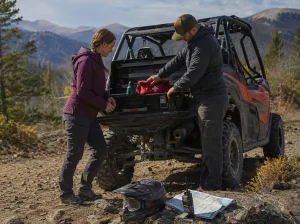
Your kit needs to be locked down in a spot where the driver or a passenger can grab it without fumbling or interfering with the controls.
Mounting solutions vary by vehicle, but consider:
- Heavy-duty, adjustable storage straps
- MOLLE panels or integrated attachment points
- A dedicated, secured vehicle compartment
- A bolted-down cargo box or protective case
The goal is simple: no sliding, no falling out, and definitely no getting buried under tools or other heavy equipment.
It’s not enough to merely say, “Yeah, we’ve got a kit.”
You need to know exactly where it is when the moment calls.
Dust Is Relentless—And Moisture Is an Uninvited Guest
Trail dust has absolutely zero respect for boundaries.
You might imagine it stays politely on the tires and exterior panels.
Think again.
That fine, pervasive grit will work its way into zippers, through mesh pockets, and even compromise supply packaging. Then there’s moisture: rain, river crossings, ambient humidity, or residual dampness from a vehicle wash can wreak havoc on gauze, adhesive bandages, and medical tape.
A truly practical off road emergency kit demands a robust bag or case. It should be easy to clean and offer a solid defense against dust and splashes.
But let’s be crystal clear:
Water-resistant does not equal waterproof.
A water-resistant bag can shrug off light rain or a bit of mud spray. It will not, however, endure an afternoon submerged in a puddle and then be declared:
“Good to go.”
After any significant rain, a deep water crossing, or a vehicle wash, open the kit and inspect its contents. Anything with torn packaging, signs of internal moisture, contamination, or compromised seals needs immediate replacement.
What Belongs in an ATV First Aid Kit?
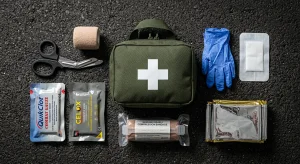
A fundamental first aid kit for trail riding should stock supplies for the common bumps, scrapes, blisters, and minor mishaps you’ll encounter on the trail.
- Assorted adhesive bandages
- Antiseptic wipes or cleansing pads
- Sterile gauze pads
- Medical tape
- Disposable examination gloves
- Elastic bandages for sprains
- Instant cold packs
- A concise first aid reference guide
Customize the contents based on your group size, trip duration, expected weather, and how far you’ll venture from paved roads.
Organize the kit intuitively. Frequently used items should be immediately accessible.
Because when someone needs gauze, no one wants to play a trailside version of:
“Guess Which Pocket It’s In.”
First Aid and Communication Gear: A Unified Front
While a first aid kit handles immediate minor situations, true remote trail safety extends far beyond bandages and gauze.
Think beyond just your ATV trail emergency supplies. Consider your mobile phones, backup power banks, pre-downloaded offline maps, GPS devices, and other reliable communication or location tools as an integral part of your safety arsenal.
The first aid kit says:
“Let’s address this injury right now.”
The communication gear says:
“Let’s ensure someone knows where we are and that help is on the way.”
That’s genuine teamwork.
Before you even leave the trailhead, check all battery levels, download any necessary offline maps, and confirm that everyone in the group understands the planned route.
Depending on your location and anticipated signal coverage, investing in satellite communication devices for truly remote areas might be a wise decision.
Don’t Overlook the Rest of Your Side-by-Side Safety Setup
A first aid kit is merely one component of a comprehensive side by side safety gear strategy.
Appropriate helmets, eye protection, properly worn seat belts or harnesses, weather-appropriate clothing, ample drinking water, essential vehicle repair tools, and robust navigation equipment are equally vital for any trip.
Your exact setup will depend on the specific vehicle, your chosen route, environmental conditions, and any local regulations.
Opting for a Tactical, Vehicle, or Outdoor first aid bag often provides a more durable and convenient solution for carrying supplies. These typically feature secure attachment points and well-organized compartments.
However, aggressive styling doesn’t magically transform a basic kit into professional rescue equipment.
MOLLE straps are practical.
They do not, however, confer an emergency medical certification on the bag itself.
Inspect Your Kit After Every Rough or Wet Ride
An ATV first aid kit isn't a "set it and forget it" item to be left on the vehicle until next season.
After any particularly dusty, wet, or demanding ride, take a few minutes to confirm:
- The bag remains securely attached.
- All zippers and closures function smoothly.
- Individual packages of supplies are still sealed.
- Adhesive products haven't degraded from heat or moisture.
- Any used or expired supplies have been replaced.
- Communication devices are fully charged and operational.
This quick check takes only minutes.
That's infinitely better than discovering, miles from anywhere, that your tape has lost its stick and your backup battery is at two percent.
A Basic Kit Is Not Professional Rescue Equipment
An ATV first aid kit serves as a foundational tool for personal preparedness and addressing minor medical needs. It absolutely does not replace trained emergency responders, professional medical care, specialized vehicle recovery equipment, or dedicated search-and-rescue services.
For severe bleeding, head injuries, respiratory distress, loss of consciousness, major vehicle accidents, or any other critical situation, contact professional emergency or rescue services immediately.
Off-road riding provides plenty of unpredictable moments.
Your safety planning should offer precisely the opposite.
A truly practical trail setup boils down to a few fundamental principles:
Secure the kit.
Protect its contents from the elements.
Keep communication and navigation tools primed.
Inspect everything before hitting the trail.
Because the trail already supplies enough drama.
Your first aid kit doesn’t need to add:
“Wait... where did it go?”
FAQ
Q1: Where should an ATV first aid kit be mounted?
An ATV first aid kit should be securely mounted in a position that’s easily accessible to the driver or passengers, doesn't impede vehicle controls, and is protected from being crushed by tools or cargo. Depending on the vehicle, a fixed storage box, a MOLLE panel, or a securely strapped rear storage area can be effective.
Q2: What essential supplies should a UTV first aid kit contain?
A basic UTV first aid kit should include items like assorted adhesive bandages, cleansing wipes, sterile gauze pads, medical tape, disposable gloves, elastic wraps, and instant cold packs. Always tailor the contents to your specific route, anticipated weather, the number of riders, and your distance from potential assistance.
Q3: Can a regular household first aid kit be used on an ATV?
While a household kit provides basic supplies, its case needs to be durable, capable of secure mounting, and offer reasonable protection from dust and moisture. A flimsy cardboard box or a loosely packed kit is unlikely to withstand the rigors of repeated off-road rides.
Q4: Why are communication and location tools important for trail riders?
Remote trails often lack reliable mobile service. While first aid supplies address immediate medical needs, offline maps, backup power sources, GPS devices, and robust communication tools are crucial for riders to pinpoint their location and summon help if required.
Q5: Is an off-road emergency kit equivalent to professional rescue gear?
No. A basic off road emergency kit supports individual preparedness but is not a substitute for professional medical services, specialized vehicle recovery equipment, or organized search-and-rescue operations. Serious injuries or vehicle incidents demand appropriate professional intervention.